
Park Rapids does something many small towns try to do but few can quite balance: it remains a working county seat while also acting like a basecamp for trails, parks, and lake time. The courthouse and other civic functions sit inside the same town that the chamber promotes for downtown shopping, festivals, food and beverage options, and recurring programming such as the 2nd Street Stage. That mix is not just branding. It shapes how the town feels on an ordinary day, because errands, government business, and recreation all share the same compact geography.
The courthouse side of Park Rapids
Park Rapids became the county seat when Hubbard County was established in 1883, and that decision gave the town a role that extends far beyond one main street. The courthouse built in 1900 still occupies a prominent place in the county complex, which is a reminder that Park Rapids is not only a place to pass through on the way to a lake. It is where local government settled, where civic memory gathered, and where the county still anchors itself.
That civic identity is reinforced by local institutions that preserve memory instead of letting it drift away. The Minnesota Historical Society notes that the Park Rapids Enterprise began in 1882, changed names, and later resumed publication as the Park Rapids Enterprise in 1954; it is still publishing. The same local history trail also points to the Hubbard County Historical Museum at 301 Court Avenue in Park Rapids. Together, those institutions tell you that this is a town with a long public memory, not a place that started over yesterday.
For residents, that matters because the courthouse area is more than an address. It is part of the town’s daily logic. The city website also routes residents toward services such as planning, water, sewer, parks, and airport information, while community education and school information sit in the same online ecosystem. Even the support system is networked. Park Rapids may be a small city, but its public life is organized like a place that expects people to use it for real tasks, not just occasional photos.
The trail side of Park Rapids
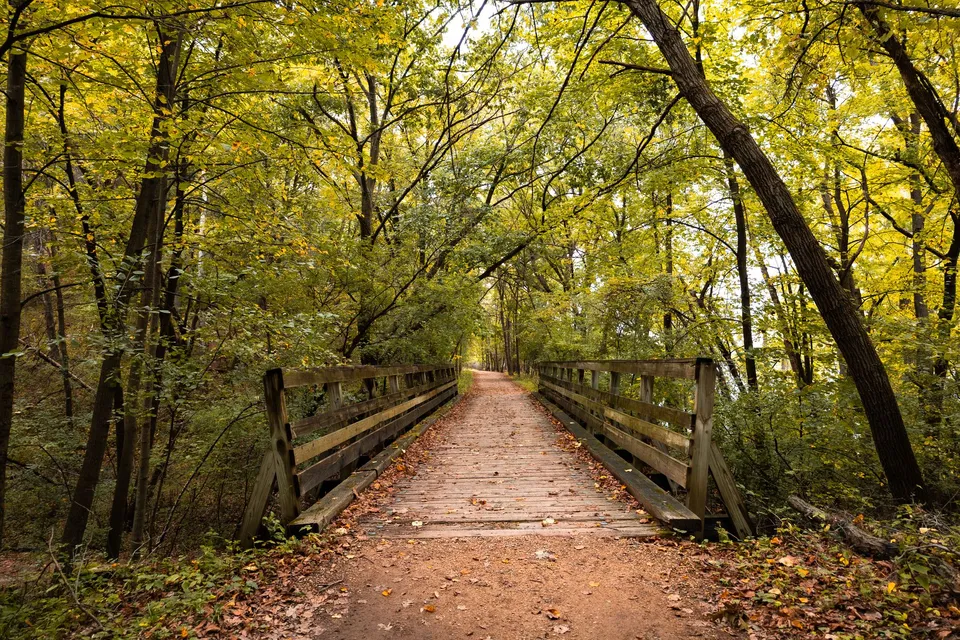
A few blocks and a bridge away, the mood changes. Red Bridge Park sits on Beach Road, covers one acre, connects by the red bridge to Heartland Park, and serves as a trailhead for the Heartland Trail. That one detail explains a lot about Park Rapids: the edge between civic town and outdoor town is not a hard line. It is a crossing point. People walk, fish, watch fireworks, and start trail outings from the same corridor.
The broader recreation system makes that corridor feel even less isolated. Hubbard County says it maintains public boat accesses and beaches at places including the Fish Hook River at Heartland Park, Garfield Lake near Laporte, and Paine Lake at Lake George Community Park. In other words, Park Rapids is part of a countywide network of access points, not a town with one park and a few scattered amenities. Residents and visitors move between city parks, county beaches, and lake access sites as part of ordinary life.
That outdoor identity also connects to the larger Heartland Lakes region. The chamber places Park Rapids inside a landscape that includes the Lake Country Scenic Byway, the Crow Wing River State Water Trail, and the wider trail-and-lake system around Akeley, Laporte, Nevis, Lake George, and other nearby communities. Itasca State Park is part of that regional travel pattern, but it is treated as a destination connected to Park Rapids, not a neighborhood inside it. That distinction matters because it shows how the town functions as a gateway without pretending to contain everything itself.
What fills the space between the two identities
The most interesting part of Park Rapids is the middle ground: the places and services that make the courthouse side and the trail side work together. Heartland Express says it provides safe, reliable transportation for Hubbard County residents, offers curb-to-curb bus service to Park Rapids and Bemidji, and can get riders around the City of Park Rapids. It also works with services such as Veterans Services, Community Education, the Development Achievement Center, Social Services, and Medicaid. That is not a side note. It is the practical glue that helps people reach both civic services and everyday destinations.
The city airport adds another layer of usefulness. The Park Rapids Municipal Airport page says the airport has 44 T-hangars available for rent and a second-floor terminal meeting room available by the day or half day. That kind of detail tells you the airport is not only about aircraft. It also serves as a small community asset with a civic function. In a town like Park Rapids, that matters because infrastructure often doubles as shared space.
Why this balance matters
Park Rapids can feel surprisingly self-contained if you stay downtown, but its real strength is that it does not ask one part of town to do everything. The courthouse gives it a civic center. The museum and newspaper give it continuity. Red Bridge Park and the Heartland Trail give it a direct link to recreation. County beaches, transit, and airport services keep it usable for people who live here, work here, or arrive with a list of errands and a few free hours.
That is why Park Rapids feels like more than a small city on the map. It is a place where the county seat, the trailhead, the downtown, and the lake country all keep meeting each other in the same few blocks and roads. If you want to understand the town, start with the courthouse, cross the red bridge, and keep going until the trail opens up. The route itself explains why Park Rapids works.