
Park Rapids Is a Town You Read by Its Routes
Park Rapids makes more sense when you stop thinking of it as a single downtown and start reading it as a set of connected routes. The city website points residents to airport, parks, public transportation, water and sewer, rental forms, planning, schools, and the chamber of commerce, while the Heartland Lakes area stretches from Osage to Akeley and from Itasca State Park to Menahga, with Park Rapids, Nevis, Dorset, Lake George, Laporte, and the spaces in between all working together. That is the local reality: the city matters, but so do the county roads, the lake edges, the trailheads, and the shared services that link them.
That network shows up immediately at the Fish Hook River. Red Bridge Park sits on Beach Road, covers just one acre, connects by the red bridge to Heartland Park, and serves as a trailhead for the Heartland Trail. In other words, this is not only a pretty park; it is a hinge point where people cross from neighborhood life into recreation and regional travel. The same corridor supports fishing, walking, fireworks, and trail access, which is why it feels bigger than its size.
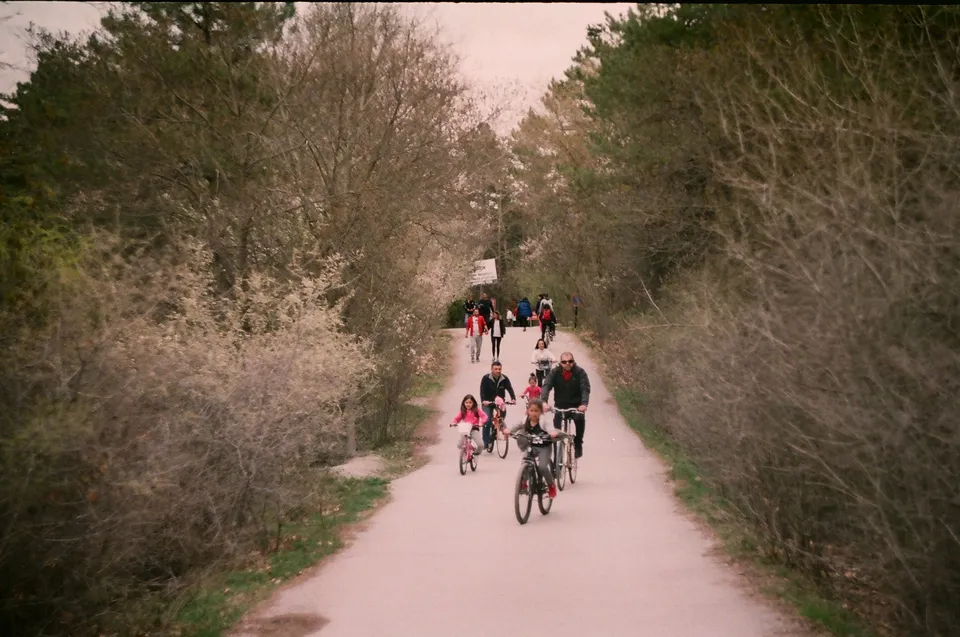
The Heartland Trail gives that idea regional weight. Hubbard County’s recreational planning materials describe the trail as starting in Park Rapids and extending to Cass Lake, and the chamber describes it as a 100-plus-mile route through a larger trail system. That matters because it helps explain why Park Rapids draws riders, walkers, and visitors who are not just passing through one town block. The trail is part of the town’s everyday geography, not a separate amenity hidden somewhere else.
Downtown, meanwhile, is not just a place to buy things. The chamber presents it as a district with shopping, festivals, food and beverage options, and a historic main-street feel, and it highlights recurring programming such as the 2nd Street Stage and community events. That makes downtown a civic room as much as a commercial one. For residents, it is where errands, music, and small encounters overlap. For visitors, it is often the first clue that Park Rapids is more than a gateway to lakes and forests.
The county park system widens the map even further. Hubbard County says it maintains public boat accesses and beaches at Stony Lake, the Fish Hook River at Heartland Park, Garfield Lake near Laporte, and Paine Lake at Lake George Community Park. Those access points matter because they show how recreation is distributed across the region instead of concentrated in one signature park. A family might use a city trail one day, a county beach the next, and a lake access near another community after that. That is the sort of routine movement that defines life here.
The same connectedness applies to transportation. Heartland Express says it provides safe, reliable transportation for Hubbard County residents, offers curb-to-curb bus service to Park Rapids and Bemidji, and can get riders around the City of Park Rapids. It also says it works with Veterans Services, Community Education, the Development Achievement Center, Social Services, Medicaid, and others. That is not a symbolic service. It is the practical mobility layer that helps people get to appointments, programs, and errands when a private vehicle is not the best or only option.
That does not mean transit solves every transportation problem. The county’s bus network reaches Park Rapids and Bemidji, but riders still need to check schedules, booking rules, and stop coverage before relying on it for work or a full day of errands. The important point is simpler: Park Rapids is not an island. It is tied to a countywide service system that makes daily life possible for people who live in town, in townships, or closer to the lakes.
Park Rapids Municipal Airport adds another layer to that local infrastructure. The airport page says it has 44 T-hangars available for rent and a second-floor terminal meeting room that can be rented by the day or half day. That detail matters because it shows the airport functioning as more than a runway. It is also a small civic and commercial facility, the kind of place that quietly supports pilots, meetings, and regional convenience without asking for much attention.
Even housing and planning fit the same pattern of connected systems. The city’s rental forms page lists rental licensing, inspection, safety guidelines, a short-term rental application, and a lodging-tax remittance form, which tells newcomers that housing is regulated and that short-term lodging is treated differently from ordinary rentals. The planning FAQ adds that development plan review can take about 60 to 90 days, while home occupations often take 30 to 60 days to review. For someone moving into the area, opening a small business from home, or remodeling a property, those review windows are part of the real timeline.
The civic story runs deeper than current services. Hubbard County was established in 1883, and Park Rapids was chosen as the county seat at the first meeting of the county commissioners. The county courthouse, built in 1900, remained the county headquarters until the mid-1970s, and the Minnesota Historical Society notes that the Park Rapids Enterprise has roots going back to 1882 and is still publishing. Those facts help explain why Park Rapids feels anchored: it has long been a county center, not just a seasonal stop.
That history is visible in the institutions that remain. The Hubbard County Historical Museum at 301 Court Avenue and the courthouse remind readers that Park Rapids has a strong public memory, while the area’s archaeological record, including the Shell River Prehistoric Village and Mound District, shows that the landscape’s meaning predates the modern city. Together, those pieces give the town a sense of depth that goes beyond one main street or one tourism season.
Read this way, Park Rapids is not defined by a single attraction or a single kind of trip. It is a place where a one-acre park links to a trail system, where a county bus route connects to a regional support network, where the airport has community uses, and where downtown, the courthouse, and the lakes all contribute to the same local story. If you want to understand Park Rapids more clearly, start by following the routes that connect it. Then pick one local stop that you have not used lately and see what it reveals about the rest of town.