
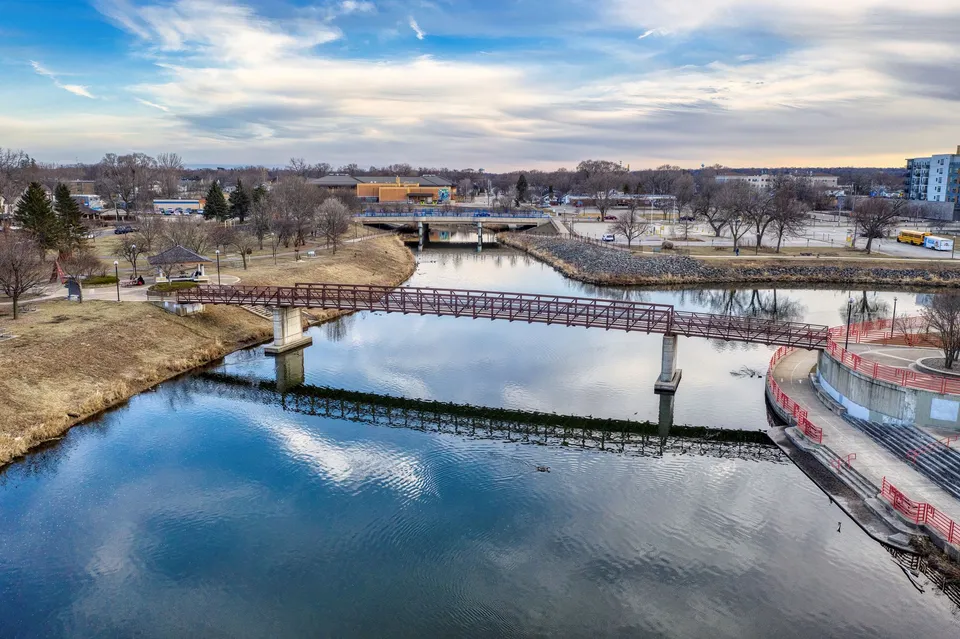
Park Rapids makes more sense when you look at the places that quietly organize daily life: the courthouse, the river park, and the ride that gets people across town and into the region. Hubbard County chose Park Rapids as its county seat in 1883, and the courthouse that still gives the city so much of its civic weight was built in 1900 on land donated by Cyrus Hollinger. That history matters because it explains why Park Rapids is not just a stop on the map; it is the administrative center for a rural county that still depends on a few anchor institutions.
A county seat is more than a building
If you are new to Park Rapids, the courthouse is one of the quickest ways to understand the town’s role. County seats pull together records, decisions, and public business that would otherwise be scattered across a wide rural area. Park Rapids has carried that responsibility for generations, and the building itself still sits inside a larger civic story that reaches back to the county’s early organization. The National Register record behind the courthouse history shows how county offices first moved from rented quarters to a county building and then to the courthouse completed in 1900, which helps explain why public memory here feels so durable.
That same sense of continuity shows up in local heritage. The Minnesota Historical Society’s newspaper record says the Park Rapids Enterprise began in 1882, changed names in the county’s early years, and resumed publication in 1954; it is still publishing today. The Hubbard County Historical Museum at 301 Court Avenue adds a physical place where that memory stays local instead of living only in archives far away. Together, the courthouse, the newspaper, and the museum show that Park Rapids is a place where civic life has a long paper trail.
Red Bridge Park is small, but it does important work
The second place that explains Park Rapids is Red Bridge Park. The city says it sits on Beach Road, covers one acre, connects by the red bridge to Heartland Park, and serves as a trailhead for the Heartland Trail. That is a lot of function for a small park. It is not only a scenic stop on the Fish Hook River; it is a connector between neighborhood recreation, a larger park, and a regional trail system.
That connection matters because it shows how Park Rapids uses its river corridor. A place like Red Bridge Park does not just offer a view; it links walking, biking, fishing, events, and everyday movement. In practical terms, it helps explain why people here think in terms of routes and connections, not isolated attractions. The county’s parks information reinforces that point by listing public boat accesses and beaches at Stony Lake, Fish Hook River at Heartland Park, Garfield Lake near Laporte, and Paine Lake at Lake George Community Park. Recreation is distributed across the county, not packed into one city park.
That spread also helps newcomers read the area correctly. Park Rapids, Laporte, Akeley, and Nevis are all part of the same working geography, but they do not collapse into one identical place. A lake access near Laporte serves a different day than a street in Park Rapids, even when both belong to the same county rhythm. The useful lesson is that local life here is regional by design.
Getting around is a regional task
The third place that tells the truth about Park Rapids is not a place at all, but a service: Heartland Express. The county transit system says it provides curb-to-curb bus service to Park Rapids and Bemidji, can get riders around the City of Park Rapids, and works with veterans services, community education, the Development Achievement Center, social services, Medicaid, and others. That is more than a bus route. It is a mobility network that helps connect daily errands, appointments, and public services across a county that is larger than its town centers suggest.
That distinction matters because Park Rapids is not a place where every need can be solved on one block or with one car trip. The city website routes residents to KRLS rather than presenting the library as a city department, which shows how everyday services are often shared regionally. The same pattern appears in education and community information, where the city and county both point people toward broader systems rather than isolated offices.
If you live here, that networked reality becomes normal. A doctor visit, a school-related stop, a county appointment, or a ride into Bemidji may all be part of the same week. Heartland Express does not remove the need to plan, but it does show that Park Rapids has a transportation structure beyond private driving alone.
Why the details matter for everyday life
Park Rapids can look simple from a distance. It is a small city, surrounded by lakes, forests, and county roads. But the practical story is more interesting. The city maintains a substantial utility system, including 1,370 water connections, 1,270 sewer connections, two water towers, five wells, and 16 lift stations. Those numbers tell you that Park Rapids is not a loose collection of cabins and storefronts; it is a place with the infrastructure of a year-round community.
The same is true for housing and local regulation. The city’s rental and planning pages show that rentals are governed by licenses, inspections, safety guidelines, and short-term rental forms. The planning FAQ says development plan review generally takes about 60–90 days, and home occupations often take 30–60 days to review. For someone thinking about moving, opening a small business from home, or remodeling a property, those are the real timelines that shape the decision.
That may sound bureaucratic, but it is part of what makes Park Rapids workable. A small county seat needs rules, routes, and utility systems just as much as it needs parks and festivals. The reward for noticing those systems is a clearer picture of how life here actually functions: civic business at the courthouse, recreation at the river, and mobility through a regional transit service.
A good first step
If you want to understand Park Rapids in one afternoon, start at Court Avenue, then walk the red bridge to the river trail, and finally check how Heartland Express handles local and regional rides. Those three stops say more about the town than any postcard ever could.