
More than a place to pass through
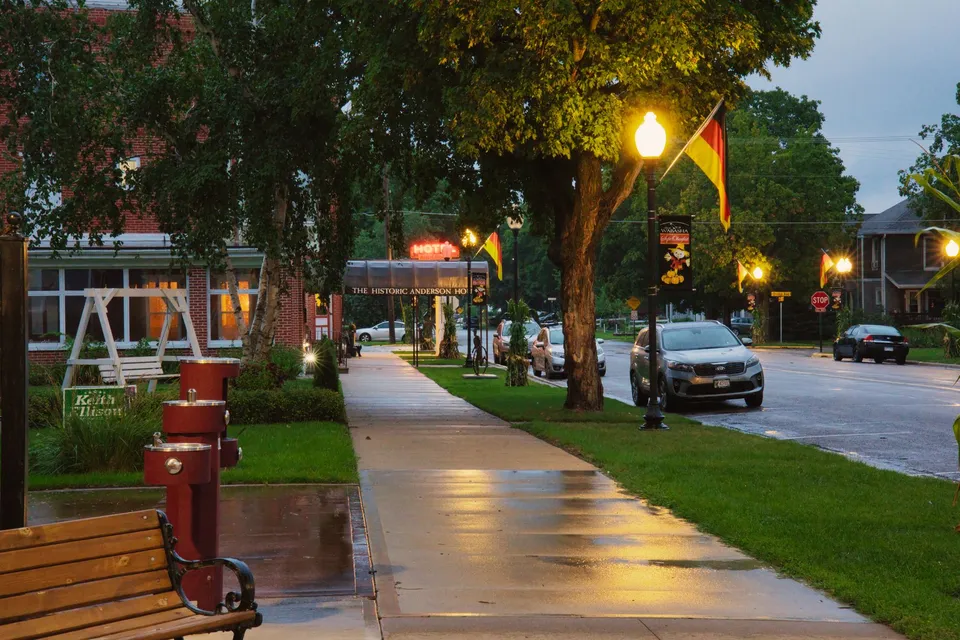
In Park Rapids, downtown is not the place you are finished with once the errands are done. It is where shopping, public memory, and trail access overlap. The Chamber’s downtown materials promote shopping, food and beverage options, festivals, and recurring programming such as the 2nd Street Stage, which shows that the district works as a social center as much as a commercial one. The city’s broader map of community life also points residents toward shared services, from parks to education, rather than treating every need as a separate destination.
That use shows up in the calendar too. The Chamber highlights recurring gatherings such as the Heartland Lakes Harvest Festival, Summer Sip Off, and the 4th of July Parade, along with music and event programming that keep people coming back to the same blocks. Those events do not turn downtown into a theme park; they make it a place where business hours, volunteer hours, and social hours overlap. For local merchants, that overlap matters. For residents, it means downtown can be both a practical stop and a reason to stay awhile.
The civic layer under the storefronts
Park Rapids became the Hubbard County seat in 1883, and that decision still shapes how the town feels. The county courthouse remains a major civic site, and the historical record says county offices first operated in rented quarters before the courthouse building went up in 1900 on land donated by Cyrus Hollinger. The local newspaper record is just as long: the Park Rapids Enterprise began in 1882, changed names with county history, and resumed its original name in 1954. Together, the courthouse and the newspaper explain why downtown has always been more than a retail strip; it is where the county has organized itself and told its own story.
The museum on Court Avenue makes that memory visible. The Minnesota Historical Society lists the Hubbard County Historical Museum at 301 Court Avenue in Park Rapids, which places local history right in the same downtown geography that still handles errands and events. That matters because it turns history from something stored away into something a person can reach on foot between other stops.
Downtown meets the river corridor
A second Park Rapids truth is that the center of town is not sealed off from recreation. Red Bridge Park sits on Beach Road, covers one acre, connects by the red bridge to Heartland Park, and serves as a trailhead for the Heartland Trail. The county plan says the Heartland Trail starts in Park Rapids and extends to Cass Lake. In practical terms, that means a visitor can move from a downtown errand to a river crossing to a regional trail without leaving the town’s daily orbit.
That trail-and-river connection is easy to miss if you think of Park Rapids as only a summer destination. But the geography works the other way too: downtown gives the recreation network a place to gather, park, eat, and linger. The Chamber’s outdoors materials place Park Rapids in a wider system that includes the Lake Country Scenic Byway and the Heartland Trail, while Itasca State Park is treated as a regional anchor rather than a city neighborhood. That distinction helps a newcomer understand why local travel often mixes town streets with regional roads and trail routes.
Why the mix matters
The value of downtown Park Rapids is not that it is pretty, though it often is, but that it compresses several functions into one compact place. A resident can catch a community event, a visitor can get oriented, and a newcomer can see how a county seat, a trail town, and a small business district fit together. Even the city website reinforces that pattern by steering people toward shared institutions such as community education and regional library services instead of assuming every service sits in a separate building. That networked pattern is part of how Park Rapids stays legible at a small scale.
The result is a downtown that does not just support Park Rapids; it explains it. You can read the town’s public life in a shop window, a courthouse block, a museum address, and a red bridge over the Fish Hook River. For anyone trying to understand the community, the best first walk is a simple one: start on Court Avenue, note the courthouse and the museum, then follow the trail connection toward Red Bridge Park and see how quickly the civic center turns into a recreation route.