
Park Rapids can look like a compact county seat from the outside, but daily life here depends on systems that reach well beyond one downtown block. A trip to an appointment, a ride to Bemidji, a meeting at the airport, or a walk across the red bridge all point to the same local truth: this town works because it is connected. The city website routes residents toward shared educational resources like KRLS and community education, while county transportation and city infrastructure help tie Park Rapids to the rest of Hubbard County and the Heartland Lakes region.
Mobility here is more than driving
In a rural place, transportation is not a side issue. It is part of how people get to work, reach services, and keep a household running. Heartland Express says it provides curb-to-curb bus service to Park Rapids and Bemidji and can get riders around the city itself. It also notes that it works with veterans services, community education, the Development Achievement Center, social services, Medicaid, and others. That makes it more than a simple bus line; it is a regional access network.
That matters because Park Rapids is not isolated, but it also is not a metro where every destination sits on the same street. The practical lesson is simple: if you live, work, or visit here, transportation can shape your day as much as weather or season. A hospital visit, a school commitment, or a county office errand may depend on whether you can match the schedule and the route. The bus service helps, but it still needs to be checked against the actual trip you need.
The airport is a small facility with a real civic role
The Park Rapids Municipal Airport is easy to overlook unless you need it, but the city treats it as a working piece of local infrastructure rather than a decorative amenity. The airport page says it has 44 T-hangars available for rent, with annual rates listed by hangar size and age, and a second-floor terminal meeting room available for rent by the day or half day. Those details show an airport that serves pilots, business users, and community needs at the same time.
That combination matters in a county seat. A small airport can support more than aviation hobbyists. It can give the area another point of contact for visitors, meetings, and local businesses that need quick regional access. It also reinforces an important Park Rapids pattern: the town’s systems are modest in scale, but they are built to do more than one job.
County government still anchors the town’s identity
Park Rapids is the county seat, and that status still shapes how the community feels. The National Register record says Hubbard County was established in 1883 and that the county seat was set at Park Rapids at the first meeting of the county commissioners. It also notes that the courthouse built in 1900 on land donated by Cyrus Hollinger remained county headquarters until the mid-1970s and still stands as part of the county complex.
That history is not just ceremonial. County-seat towns tend to gather the practical work of a region: administration, records, public meetings, and civic memory. In Park Rapids, that role sits beside other year-round institutions such as the school district, city utilities, and local transportation. The result is a community that serves nearby townships, lake property owners, and smaller towns such as Akeley, Laporte, and Nevis, even though those places are separate municipalities with their own identities.
The river corridor turns recreation into a route
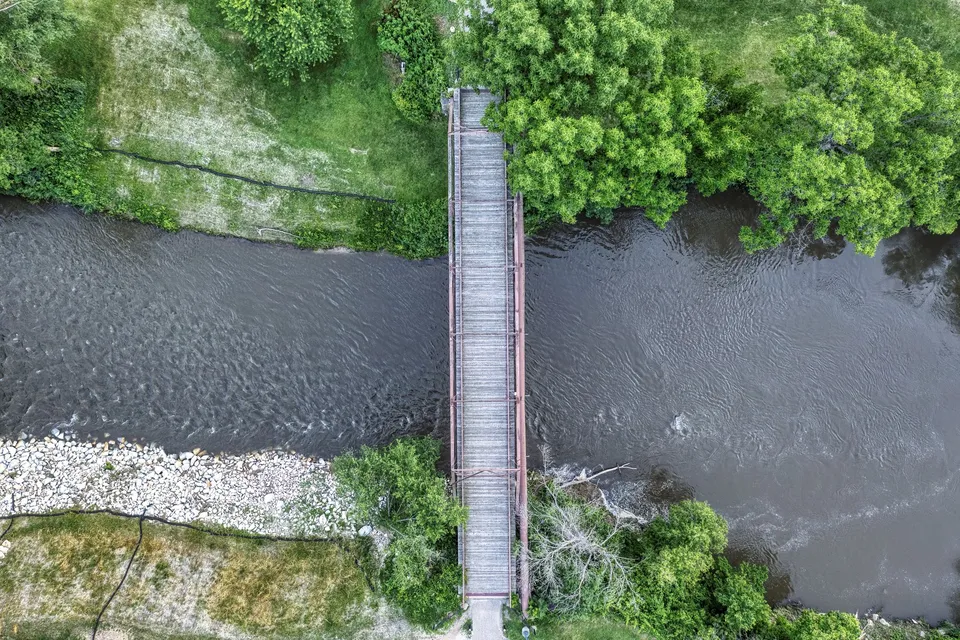
If you want to see how Park Rapids links place and movement, start at Red Bridge Park. The city says the park sits on Beach Road, covers one acre, connects by the red bridge to Heartland Park, and serves as a trailhead for the Heartland Trail. That is a lot of function for a small park. It is a place to fish, walk, watch fireworks, and enter a larger trail system all at once.
This matters because it shows how recreation and daily life overlap here. The Fish Hook River corridor is not only scenic; it is a connector. It links downtown-adjacent space, parkland, and the trail network in a way that makes the town feel bigger than its size suggests. For residents, that means an ordinary evening walk can also be a practical route. For visitors, it explains why Park Rapids is often understood through movement between downtown, parks, and trails rather than through any single landmark.
Why these networks matter together
Taken one by one, the bus, the airport, the courthouse, and the red bridge may seem like separate details. Together, they explain how Park Rapids functions. Transportation gets people to services. The airport gives the area another layer of access. The courthouse and county offices remind everyone that this is a regional center, not just a bedroom community. The trailhead and park corridor show that even recreation is woven into the town’s circulation.
That is the real shape of Park Rapids: a small city that depends on shared systems, regional links, and useful public places. If you are new here, a good first step is to look at the city’s transportation information, then take a walk across the red bridge and see how the courthouse, downtown, and trail network all fit together.