
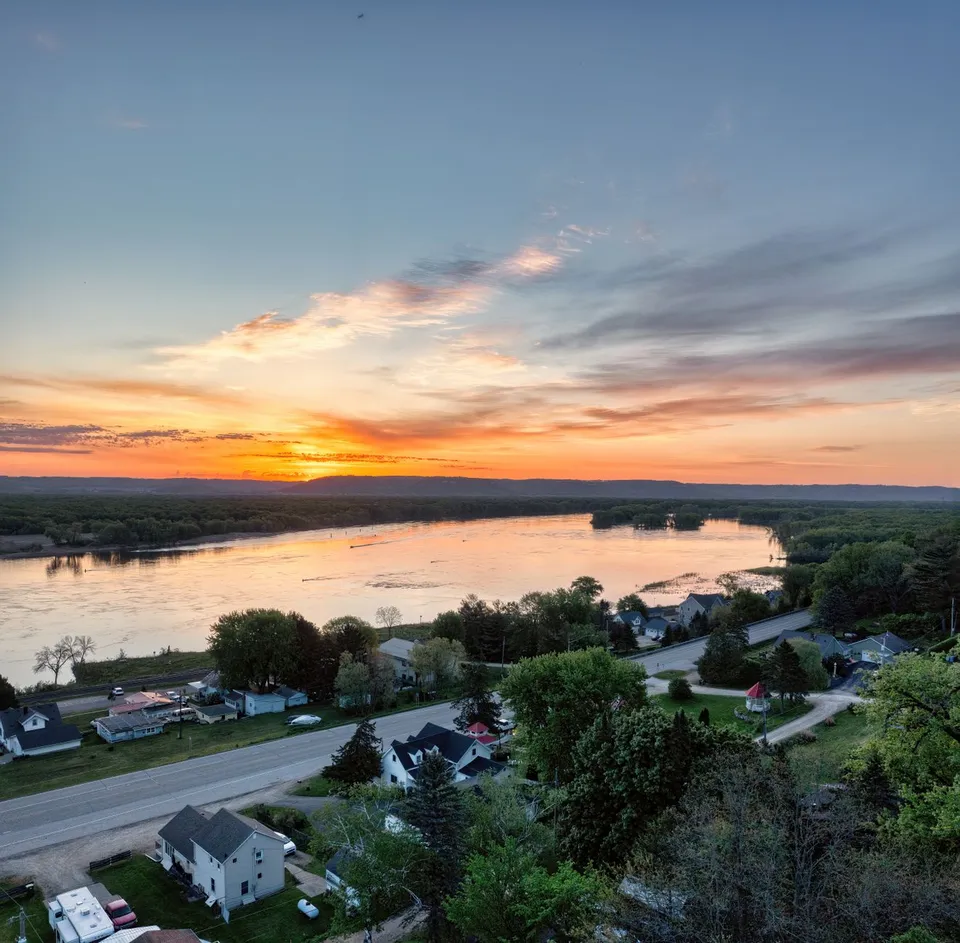
Park Rapids is easiest to understand when you stop thinking about it as one neat downtown and start thinking about it as a series of short, ordinary trips. Walk from Main Street to the Fish Hook River. Drive from the county courthouse to the airport. Catch a ride from town to Bemidji. Each trip points to a different layer of the same place: civic, recreational, and regional. The city’s own website, the county pages, and local service directories all show a town whose real center is built from connections, not just blocks.
The river corridor is a working part of town
Red Bridge Park is small—just one acre—but it does a lot of work for Park Rapids. The city says it sits on Beach Road, connects by the red bridge to Heartland Park, and serves as a trailhead for the Heartland Trail. That makes the Fish Hook River corridor more than scenery. It is a place where people fish, walk, gather, and start onto a longer route that reaches beyond the city limits. The county’s recreation materials add that Heartland Trail begins in Park Rapids and extends toward Cass Lake, which helps explain why the park feels bigger than its footprint.
That same corridor also fits into a wider county pattern. Hubbard County maintains public boat accesses and beaches at places such as Stony Lake, the Fish Hook River at Heartland Park, Garfield Lake near Laporte, and Paine Lake at Lake George Community Park. In other words, Park Rapids is not the only access point for everyday recreation; it is one node in a network of public water and park access across the Heartland Lakes area. For residents, that matters because a “day out” can start in town and end at a lake or trailhead without ever feeling disconnected from local life.
County government still shapes the town’s daily rhythm
Park Rapids became the Hubbard County seat in 1883, and that decision still echoes through everyday life. Historic records show the county first operated in rented quarters, then in a building erected by Todd Township, and later in the courthouse built in 1900 on land donated by Cyrus Hollinger. The courthouse remained the county headquarters until the mid-1970s, and it still anchors the county complex today. That history matters because it explains why so much of the region’s business, paperwork, and public memory still runs through Park Rapids.
The county-seat role is not just symbolic. The local economy includes a substantial public-sector and institutional base: schools, utilities, transportation, planning, and county services. The school district’s career-readiness page points students toward job shadowing, interest assessments, finance classes, the ASVAB, YouScience, and CAREERwise. That tells you something important about the local workforce story: Park Rapids is not only a place where people work in visitor-facing jobs; it is also a place that has to prepare young people for the broader mix of education, care, public administration, and trades that actually keep a rural county functioning.
Getting around is a regional question, not just a local one
The strongest transportation clue in Park Rapids is that mobility is shared. Heartland Express says it provides curb-to-curb bus service to Park Rapids and Bemidji and can get riders around the city itself. It also works with veterans services, community education, social services, Medicaid, and other partners. That means a resident’s real access to appointments, classes, and errands is often tied to county transportation rather than to a private vehicle alone. It is a practical network, but it still requires riders to check schedules and stop coverage before depending on it for work or an appointment.
Park Rapids also has a municipal airport that functions as more than a strip of pavement. The city says the airport has 44 T-hangars for rent and a second-floor terminal meeting room available by the day or half-day. That combination tells you the airport serves private aircraft owners, small business users, and community meetings at the same time. Add the city’s utility system—1,370 water connections, 1,270 sewer connections, two water towers, five wells, and 16 lift stations—and you get a clearer picture of the town’s scale: small enough to feel local, but structured enough to support year-round living.
Housing, learning, and everyday services are shared systems
Newcomers often assume that a small town handles everything locally. Park Rapids shows why that is only partly true. For libraries and informal learning, the city routes residents to KRLS rather than running the library as a city department. For housing, the city posts rental-license forms, inspection checklists, safety guidelines, short-term rental paperwork, and ordinance information. For planning, it says development review often takes 60 to 90 days and home occupations may take 30 to 60 days to review. Those details matter because they show the town is organized, but not simplistic: living here means working with a system of county, city, and regional services, not just choosing a street address.
That same shared-system idea helps explain the feel of downtown. The chamber describes downtown as a place for shopping, festivals, food, and a historic main-street atmosphere, while recurring events such as the 2nd Street Stage help keep the center active. Park Rapids also has a long public memory: the Park Rapids Enterprise has published under several names since the 1880s and is still publishing today. Put together, those facts suggest a town that keeps renewing itself without losing the institutions that let people recognize where they are.
Park Rapids makes the most sense when you read it as a network of trips: river to trail, city to county, home to regional service. If you are new to the area, start by looking at the red bridge, the courthouse, and one practical route—whether that is a bus line, an airport hangar, or a downtown errand. Those everyday movements tell the story better than a map alone.